
Blog
Welcome to our new “Blog” page. It’s something we’ve been talking about for a while, and now here it is! We will post things of interest; new products as they come along, reminders of the benefits of having a central vacuum in your home, handy hints to keep it operating smoothly, and more.
A reminder that all our vacuum systems and accessories are sourced from Italy and Germany, hence our name European Central Vacuum Systems. The brands we sell are; from Italy TUBÒ residential systems, AIRÒ PROFESSIONAL commercial systems and coming soon, a new range, AER-HYBRID residential systems. And from Germany, the BVC range of residential systems. “Experience European Excellence”.
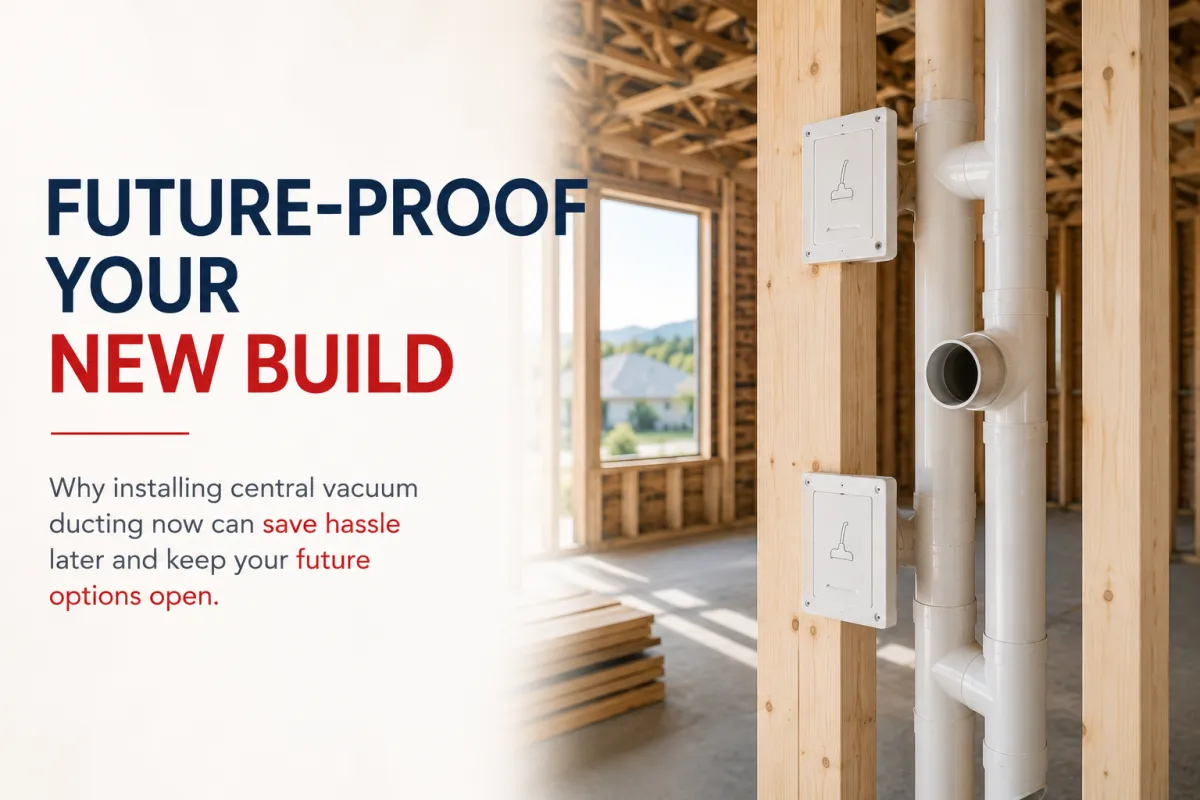
Future-Proofing Your New Build: Why Central Vacuum Ducting Is Worth Considering Now
Future-proofing a new home is not a new concept. It’s been happening for years.
When you’re building, it makes sense to think ahead and install things such as data cabling, security wiring, sound systems and other infrastructure while the walls are open and everything is easily accessible.
But there’s another future-proofing option that is often completely overlooked: installing the ducting for a central vacuum system. You may want a central vacuum system eventually, but perhaps it isn’t high on the must-have list when you’re building. There are plenty of things competing for your budget during a new build, and some will naturally take priority.
That doesn’t mean you have to rule out a central vacuum system altogether. By installing the ducting during construction, you can have the infrastructure ready and add the power unit and complete the system later, when the time and budget are right.
Why install central vacuum ducting during the build?
The simple answer is access.
During construction, the wall cavities, ceilings and floor spaces are accessible, making it relatively straightforward to plan and install the pipework required for a central vacuum system.
Once the house is finished, things become more complicated.
It is not impossible to retrofit central vacuum ducting into an existing home, and we do install systems into existing properties where the construction allows it. However, there are considerably more limitations to work around.
If you already know there is a possibility that you may want a central vacuum system in the future, installing the ducting during the build makes sense. You are effectively keeping that option open.
You don't have to install the complete system now
This is probably one of the most important points.
Future-proofing your home with central vacuum ducting doesn't mean you have to purchase the complete central vacuum system at the same time.
The ducting can be installed as part of the build, with the inlet points positioned around the home and the pipework concealed within the structure. Then, when you're ready, a suitable power unit can be installed to complete the system.
At European Central Vacuum Solutions, we supply German-designed and manufactured
BVC central vacuum systems, so we can help you choose the appropriate system when the time comes.
It could be shortly after you move in. It could be several years down the track. The important part is that the infrastructure is already there.
How much does it cost to future-proof a new home?
As an example, let's look at the cost of installing ducting for a five-inlet central vacuum system in a new build.
The cost is approximately $1,926.25 including GST.*
To put that into perspective, consider a 175m² home.
Depending on the type and quality of the build, the overall construction cost could range from approximately $437,500 for a more budget-conscious build through to $1 million or more for an architectural or custom home.
Against those example build costs, $1,926.25 represents approximately:
0.44%–0.34% of a $437,500–$560,000 standard or budget build
0.34%–0.24% of a $560,000–$787,500 mid-range build
0.24%–0.18% of a $787,500–$1,050,000 architectural or custom build.
Now, I'm biased, but wouldn't you say that's worth considering as an investment in the future? Particularly when installing the ducting later could be considerably more difficult.
*Pricing is indicative and will depend on the design and requirements of the individual home.
Contact us for current pricing for your project.
Think about the home you might need in the future
When we're building a house, we naturally think about what we need today. But homes generally last a lot longer than our current circumstances do.
You might have pets in the future. Your family might grow. Your cleaning requirements could change. You may simply decide that dragging a portable vacuum cleaner from room to room and up and down stairs is something you would rather not do anymore.
Central vacuum technology will continue to develop too. By installing the ducting now, you aren't committing yourself to a particular power unit today; you're simply creating the infrastructure that allows you to take advantage of a central vacuum system later.
What about resale?
There is another person worth considering when you future-proof your home: the person who might own it after you. You may have no intention of selling when you build, but circumstances change.
When the time eventually comes, having central vacuum ducting already installed gives a prospective buyer another option.
Perhaps a central vacuum system is something they've had before and specifically want in their next home. Perhaps they have pets, allergies or simply want a convenient whole-home cleaning system.
If the ducting is already installed, adding the system is relatively straightforward. If it isn't, they have to consider whether retrofitting is practical.
Will central vacuum ducting single-handedly sell your house? Of course not.
But it is another piece of infrastructure that demonstrates the home was designed with the future in mind.
Plan the inlet locations while you plan the house
Installing the system during construction also allows you to think properly about where the vacuum inlets should go.
We don't believe in installing as many inlet valves as possible. The aim is to install as many as necessary and as few as possible. Their locations can be planned around the layout of the home so that the hose can comfortably reach the areas that need cleaning.
For a typical single-family home, this may mean positioning inlets strategically through the living areas, hallways and other locations, with an additional inlet in the garage wherever appropriate.
Planning this while the home is still on the plans allows us to create a practical system without unnecessarily filling your walls with inlet points.
Building a new home? Ask the question now.
There are plenty of decisions to make during a new build, and a central vacuum system may not be at the top of your list.
That's fine.
But before the walls are closed, it is worth asking whether you might want one in the future.
Installing the ducting now gives you that choice.
If you are planning a new build and would like to know what would be involved in future-proofing your home for a European Central Vacuum Solution, talk to us while you're still in the planning or construction stage.
We can help you work out how many inlet points you need, where they should go and what is required to prepare the home for a central vacuum system when you're ready.
Call Tony on 027 69 287 00 or email contactus@eurocentralvacs.co.nz to discuss your new build.
FAQ
Can you install central vacuum ducting without buying the vacuum system?
Yes. The ducting and inlet points can be installed during construction, with the power unit added later when you'e ready.
When should central vacuum ducting be installed in a new build?
Ideally, it should be planned before the walls and ceilings are closed so the pipework can be incorporated into the structure of the home.
How many central vacuum inlets does a new home need?
This depends on the home's size, layout and hose length. The aim is to use as few inlet points as practical while still providing convenient coverage throughout the home.
Can a central vacuum system be retrofitted into an existing home?
In many homes, yes, but installation can be more complicated once the house is complete. Installing the ducting during construction keeps the process much simpler if you decide to add a system later.

Get in touch
Address
19 Fitzherbert St., Alicetown, Lower Hutt, 5010
Email Address
Phone Number

Copyright © 2024 Euro Vacuum System | Website Design by Virtual Innovation